
Trevor Carlson Interview
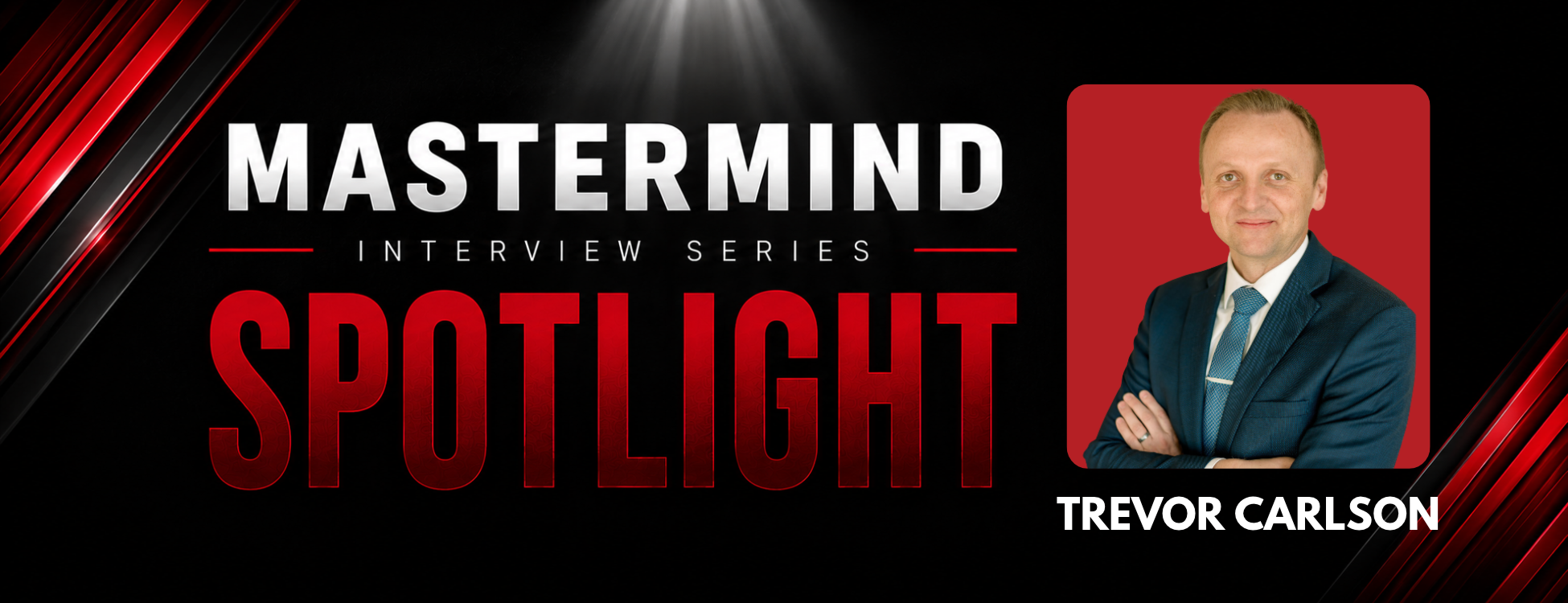
Trevor Carlson has built his career around helping homeowners make smarter decisions about one of their most valuable assets: their home. After entering the mortgage industry just before the Great Recession, Trevor went on to help more than 1,700 families and originate hundreds of millions of dollars in loans, while developing a specialty in reverse mortgages and helping older homeowners better understand how their home equity can support their financial goals.
In this Mastermind Spotlight, Trevor shares lessons from nearly two decades in the mortgage industry, including the value of specialization, building trust through education, developing strong referral relationships, and finding opportunities other mortgage professionals may overlook. He also discusses what navigating difficult markets has taught him about resilience, purpose, and creating lasting value for clients and referral partners.
You entered the mortgage industry just months before the Great Recession began. What did surviving such a difficult period so early in your career teach you that still influences how you run your business today?
Nobody likes a tough market, but all of the top producers I’ve known claim that their greatest breakthroughs and career advances came during, or as a direct result of, the tough markets, not the easy ones.
Markets move like the waves of the ocean. They come and go. Sometimes it feels like they’ve gone out further than you’d like, but just like a wave, the further they go out, the further they come back in. That’s what helps me stay engaged in the work of preparation for what’s coming, because I know today’s difficulty brings tomorrow’s reward, and the greater the difficulty, the greater the reward.
You've made the decision to become highly specialized in reverse mortgages rather than trying to be everything to everyone. What has specialization done for your business, and what can other loan officers learn from that approach?
Specialization is the great secret of success for me. The temptation to do everything and turn away nothing is real for all of us, but I’ve learned from quotes by Steve Jobs and Warren Buffett that you have to say no to 99 good things to be able to say yes to one great thing.
Being specialized in one product makes me better than 99% of people who “offer” reverse mortgages. It has made my career easier and more successful, and it’s made it so I can deliver far better experiences to my clients.
Reverse mortgages are often misunderstood by consumers and even some mortgage professionals. What's the biggest misconception you encounter, and what do loan officers need to better understand about how HECMs can fit into a homeowner's broader retirement strategy?
Keep it simple. Everyone overcomplicates it unnecessarily. A reverse mortgage is a mortgage with deferrable payments. It’s that simple. Yes, there are some minor ins and outs you have to understand, but if a mortgage professional understands a deferrable student loan, they should understand a reverse mortgage.
Loan officers need to understand that they are really financial planners. Homeownership is responsible for the single largest asset most Americans will ever own. It is also their largest expense.
Mortgage planning really is retirement planning, and when done right, what we do as professionals will far outpace what a client’s financial planner will do in terms of building and retaining wealth. Understanding this doesn’t place a reverse mortgage as a last resort. It places it as an intentional outcome to allow people to leverage the wealth they build through homeownership.
Many loan officers focus almost entirely on traditional purchase and refinance business. What opportunities could they be overlooking by not developing relationships with older homeowners and the professionals who advise them?
There are 69 million Baby Boomers in America. Of this demographic, 78% are homeowners, which is the largest percentage of any demographic. They also tend to have more average wealth because of their homes and better credit than any other demographic. They also have the greatest need because of low fixed incomes.
The Social Security Administration reports that two-thirds of retirees rely on Social Security as their primary source of income, and the average check this year is around $1,900.
With rising costs for gas, medical care, and other expenses, the economy is driving us toward a breaking point, and Social Security is the one-legged horse that is our best hope for help.
Home equity is the future of retirement, not because we want it to be, but because we’ll need it to be. There just aren’t any other options for retirees who don’t want to go back to work at Taco Bell for $12 an hour.
Reverse mortgage conversations can involve retirement, finances, family members, and someone's home, making trust especially important. What have you learned about explaining complex financial products in a way that educates clients without overwhelming them?
Something I’ve learned from marketing gurus over the years is that when you give a presentation or produce marketing, you should always look for a way to say what you want to say, but with 25%–50% fewer words.
Likewise, use words, terminology, metaphors, and methods that would make it understandable to a sixth grader. Never talk down to people, but find a way to educate them using extreme simplicity. This will make them feel intelligent and create trust in you as well.
A phrase I often use is, “If you were my parents, I’d recommend…” I don’t use this to manipulate. I use it genuinely because I treat all of my clients like they are family, so I’m always putting them above my commissions.
You've helped more than 1,700 families throughout your career. After that many transactions, what have your clients taught you about what borrowers truly value from their loan officer?
Nothing creates a more defensive attitude in people than when you deal with their family and their money. With mortgages, we’re doing both.
To be great at what we do, we have to recognize our true position in the transaction. We aren’t the opposition or the antagonist. We are the assistant. We are here to help them on this path, and we need to recognize that fact. More importantly, we have to help them recognize and feel that relationship as well.
When our clients feel they are partnered with us, our job gets a lot easier.
Financial planners, Realtors, attorneys, CPAs, and other professionals can all encounter clients who may benefit from accessing home equity in retirement. How do you build relationships with referral partners who may initially know very little about reverse mortgages?
Recognize that it’s always about “me,” meaning them. In order to add value to a potential partner, we need to understand what value they are looking for.
We need to put ourselves in their shoes, get to know their perspective, and ask questions to understand them better. Then, we need to work to answer the question: If I were in their shoes, what would be valuable to me about partnering with someone like me?
If we have value to add, we’ll be top of mind to our partners. If we don’t, we are forgettable and replaceable.
Don’t guess what value you think they are looking for. Get to know them and get in their shoes.
You've said your mission is to make life better for everyone you touch. How has having a clear purpose influenced the way you make decisions, lead your team, and measure success beyond production numbers?
Building up my team makes my life better and easier. When my team is able to do more, they do more for me. So how could I not be focused on building them up?
We live in a reflective universe. The good we give out only gets reflected back to us and is often magnified.
It’s important to always remember that any sacrifice I can make to build others up, give to others, or help others will only come back to me in multiples. So it is always worth it to do the right thing.
You've worked with everything from conventional and jumbo loans to FHA, VA, USDA, and HECMs. What did working across so many different areas of mortgage lending teach you about finding the niche where you can create the most value?
One of my favorite lessons is that we get to choose our lives.
I love reverse mortgages because I love the people, and I love helping people make the most meaningful impact possible on their lives through a mortgage.
I similarly loved working with first-time buyers because it was such a big deal when we closed their loans.
It doesn’t matter what your niche is, whether it’s a loan product, a referral source, a business specialty, or whatever. Striving to be the best at something that matters to you and brings you joy will accelerate your ability to succeed and advance.
Don’t grind because you have to. Grind at something you love to do, and it won’t feel like a grind.
For a loan officer who has built a solid traditional mortgage business but wants to add reverse mortgages to their toolkit, what's the best way to begin learning the product and building credibility without attempting to become an expert overnight?
Lean into it. This is one of those things where good intentions for the future are never going to be enough.
Like anything you’ve ever set out to accomplish, you have to own the identity of someone who is good with this product, and you have to dedicate some time to failing forward as you find ways to be successful at it.
If it were easy, everyone would do it, but they don’t. So understand that it will take some effort and time, and just start taking those first steps to assume the identity of what you want your new business to look like.