
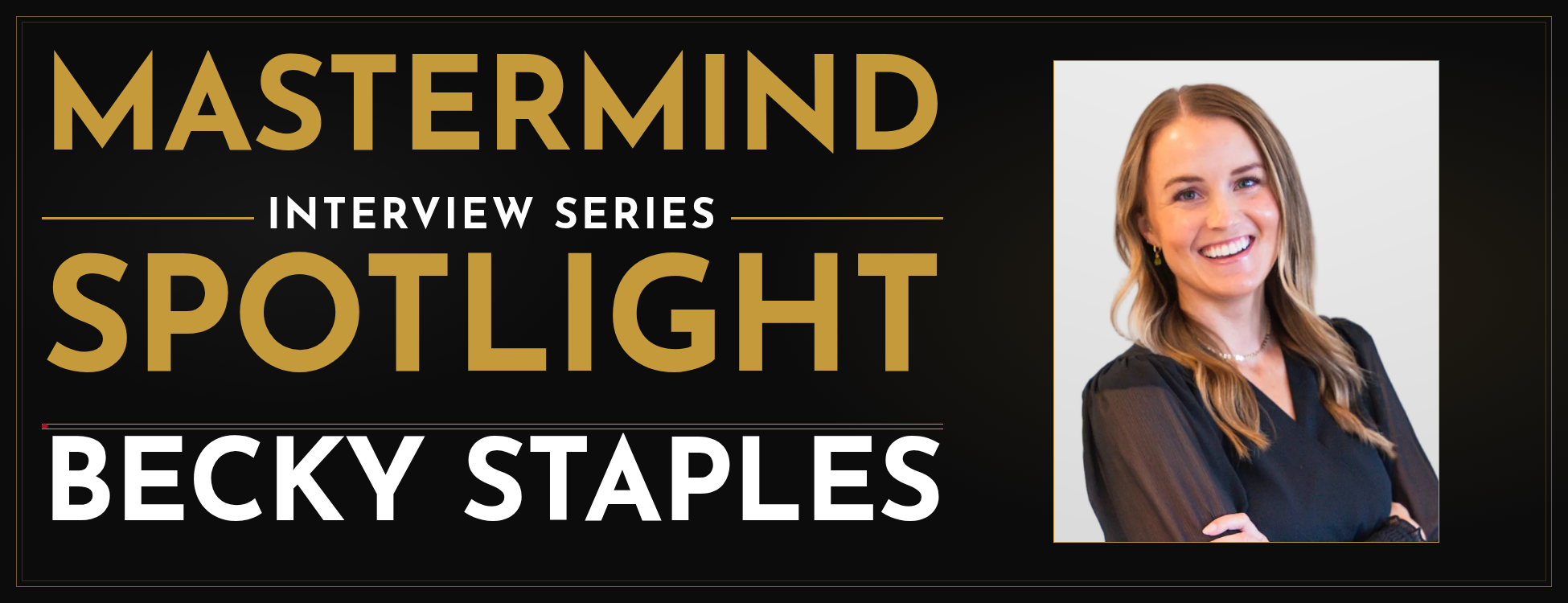
Becky Staples has funded more than $1 billion in loans over a 20-year career, and she has done it by mastering the fundamentals many loan officers are tempted to skip. While much of the industry chases the next new strategy or piece of technology, Becky has built her business on courting referral partners, nurturing her database, and showing up consistently, year after year.
In this Mastermind Spotlight, Becky shares how she learned to delegate and run her business like a CEO, why understanding your genius zone is the first step toward building the right team, and how simple, clear communication builds confidence with borrowers. She also discusses creating a premium client experience without being available every minute, and the disciplines she doubles down on when the market gets tough.
You’ve built a business around doing the fundamentals at an extremely high level. Which fundamentals do you believe loan officers are most likely to overlook as they search for the next new strategy or technology?
Everyone is so focused on AI and the next big technology right now, and while I absolutely believe there’s value in those tools, I think we’re overlooking some of the most basic, tried-and-true fundamentals of building a mortgage business.
The first is simply courting the referral partners you want to work with.
Find people who are like you, who do business the way you do, and who you genuinely want to build relationships with. That might be real estate agents, insurance agents, attorneys, financial planners, or other professionals.
And then court them! Sometimes that takes six months, a year, or even longer. But being pleasantly persistent, consistently showing up, and providing value over and over again will eventually open doors.
I think a lot of loan officers underestimate the tenacity this requires. It’s almost like rejection therapy. You’re going to hear no, you’re going to get ignored, and you’re going to have to keep showing up. But eventually, you find those partners where there’s a mutual desire to work together, refer business, and help each other grow.
That kind of relationship building is one of the most overlooked fundamentals in our industry.
The second is building and nurturing your database from day one.
If you’re a brand-new loan officer, start capturing and organizing your database now. Set it up correctly, and make sure it’s something you can maintain and take with you throughout your career, subject to applicable company policies and data privacy requirements.
Your database can become one of your most valuable business assets over time, but only if you’re intentional about staying connected to those people.
That means consistently providing value. We use tools like Homebot and Home Report to keep clients informed about their homes. We send newsletters, offer annual mortgage reviews, and regularly check in to see how they’re doing and whether their financial goals have changed.
And it doesn’t always have to be a phone call. Sometimes it’s just a few thoughtful questions in a text message. The important thing is maintaining the relationship and staying top of mind.
As you get further into your career, you’ll find that more and more of your business can come from your past clients, whether they’re returning for another loan or referring someone they know.
And here’s where these two fundamentals come full circle: When your past clients come back to you, you have opportunities to refer that business back to your real estate partners. Now you’re not just asking them for referrals. You’re helping grow their businesses, too.
I think loan officers sometimes get so distracted looking for the next big thing that they forget how powerful these simple fundamentals are when they’re done consistently over a long period of time.
You’ve funded more than $1 billion in loans throughout your career. As your production grew, what had to change about the way you managed your time, your team, and your business?
The biggest thing I had to learn was how to delegate. I had to learn how to build a team, develop systems, and stop trying to do everything myself.
That’s really what I spoke about at Mastermind, because it’s the only way I’ve been able to grow my business to where it is today, and it’s how I plan to continue growing.
You have to start thinking of yourself as the CEO of your business, not just a loan officer.
That means building the right team, putting the right people in the right roles, and creating systems that allow your business to operate without you having to personally touch every single thing.
And then you have to continually refine those systems. Team building isn’t something you do once and check off your list. I’m constantly evaluating what’s working, what isn’t, and where we can improve.
One of the biggest lessons I’ve learned is to delegate, delegate, delegate!
I try to look at what I’m doing throughout the day and ask myself, “Would a CEO be doing this?” And if the answer is no, I need to figure out who on my team can take ownership of it.
That doesn’t mean I’m not involved in my business. It means I’m intentional about where I spend my time and energy so I can focus on the things that actually require me.
I truly believe that if you want to scale, you have to stop being the person who does everything and become the person who builds the team and systems that make everything possible.
I’ve developed an entire team-building process around this philosophy, and it’s something I’m always happy to share with other loan officers who want to grow their businesses.
Systems are a major part of how you operate. What’s one process every loan officer needs to have dialed in before they can realistically expect to scale?
I don’t know that there’s just one specific process every loan officer needs to have dialed in, but I do think there’s one thing you need to figure out before you can really scale: Understanding your strengths, identifying your genius zone, and building your team around that.
I think taking a personality assessment like DISC is a great place to start. Understand how you’re wired, what you’re naturally good at, what you enjoy doing, and where you bring the most value to your business.
And then, just as importantly, recognize what you’re not good at or what you simply don’t enjoy doing.
One of the easiest ways to identify those things is to look at your to-do list. What keeps getting pushed to tomorrow? What keeps getting moved on your calendar week after week?
A lot of times, those are the things you don’t want to do, and whether you realize it or not, you’re becoming the bottleneck in your own business.
I think the goal should be to spend as much of your time as possible working in your genius zone and then hire people whose strengths complement yours.
And you don’t need a huge team to start doing that. Start with one great assistant who can take some of those responsibilities off your plate. As your business grows, you can continue adding team members and building out your systems.
But the foundation is really understanding two things: What do I love doing, and what am I exceptionally good at?
Once you figure that out, start finding people who can take ownership of everything else.
That’s how you begin removing yourself as the bottleneck and building a business that can actually scale.
Growth can sometimes create more complexity and stress instead of more freedom. How can loan officers recognize when their business has become unnecessarily complicated, and where do you recommend they begin simplifying it?
I think you’ll know when your business has become too complicated because you can feel it. There are too many moving parts, things feel heavier than they should, and processes that should be simple become unnecessarily difficult.
One of the biggest things I’ve learned is to listen to the feedback from your clients, referral partners, and team.
I intentionally have someone other than myself ask our borrowers for feedback at the end of the loan process. Recently, we kept hearing the same feedback, which caused me to reevaluate how our team was structured. We made some adjustments that simplified the process for both our borrowers and our team.
It’s important to constantly pay attention to the heartbeat of your business and be willing to make changes.
That’s where thinking like a CEO comes in. You have to recognize when something isn’t working, take the time to evaluate it, and make the necessary adjustments.
You can’t be so busy working in your business that you forget to work on your business. That’s how you continue to grow without adding unnecessary complexity.
You’re known for making complicated lending scenarios easier to understand. What have you learned about communicating complex financial information in a way that builds confidence and trust with borrowers?
I tell my team this all the time: We do mortgages every single day, but most of our clients haven’t done this in years, and some have never done it at all. We have to remember who our audience is and communicate at their level.
I always encourage my team to explain the why behind things and make it simple enough that a fifth grader could understand it, without ever sounding condescending.
I’m also a huge believer in visual presentations. Tools like MBS Highway and Mortgage Coach are incredibly valuable because most people need to actually see the numbers to make an educated decision. Showing comparisons, break-even points, and how different loan options impact their finances makes complicated decisions much easier.
And sometimes it’s the simplest things that make the biggest difference. For example, stop sending clients long, overwhelming emails! Use bullet points, be concise, and get straight to the point. People are much more likely to understand and respond when information is easy to digest.
I also think it’s important to recognize how different people process information. Some clients are very analytical and want all the numbers, while others need a simpler, big-picture explanation. You have to adapt your communication style to the person sitting in front of you.
Ultimately, it’s about taking a consultative approach. Ask good questions, understand their goals, and help them see how the numbers relate to their actual lives.
When you can take something complicated and make it feel simple, you build confidence, earn trust, and create clients for life.
You take an active role in your clients’ loans while also relying on an experienced team and in-house operations. How do you determine what deserves your personal attention and what needs to be handled by your team?
I try to focus my time on the things that truly need my expertise, like loan structuring, presenting options, and helping clients make decisions based on their financial goals. But I’ve also learned that just because I’m good at something doesn’t mean I have to be the one doing it.
For example, I’ve spent years training my production partner, and she now handles about 50% of the client consultations I used to do myself.
One of my biggest priorities is teaching my team to become problem-solvers instead of relying on me for every answer. I always tell them, “Absolutely make me aware of problems as they come up, but I also want you to think through a few possible solutions and come to me with your recommendations rather than expecting me to have all the answers.”
Just today, I let my team work through something I could have solved in minutes. But I knew they could figure it out, and allowing them to do that means they won’t need me the next time.
It takes patience to train and empower people, especially when doing it yourself would be faster. But you can’t be the coach and the player at the same time. At some point, you have to step back, trust your team, and let them grow.
That’s how you build a business that can scale without everything depending on you.
You’ve worked with thousands of borrowers with different financial situations and goals. What have those experiences taught you about asking better questions before recommending a mortgage strategy?
One of the biggest things I’ve learned from working with thousands of borrowers is that every client is different, and you have to learn how to read people. Some need more guidance and reassurance, while others are comfortable making decisions with less involvement.
The more people you work with, the better you become at recognizing those differences and adapting your approach.
I think one of the most valuable skills you can develop is learning how to get people talking. Ask thoughtful questions, really listen to their answers, and help them think through what matters most to them.
My goal is to guide clients through their options in a way that allows them to almost arrive at the solution themselves. I’m still making recommendations and providing the expertise, but by asking the right questions and presenting the right information, they begin to recognize which option makes the most sense for their situation.
When clients feel like they’ve been part of the decision rather than simply being told what to do, they have so much more confidence in the mortgage strategy they choose.
Many loan officers believe delivering exceptional service requires constantly being available. How do you create a premium client experience while also establishing a business that is sustainable for you and your team?
I tell my clients and referral partners they’re welcome to reach out nights and weekends, and I mean that. Especially with my real estate partners, I want them to know I’m available because their business doesn’t always happen between 9 and 5.
But as my career has progressed, I’ve learned that exceptional service doesn’t require being available every minute. It requires being proactive and having the right systems in place.
My team and I prepare open house materials, items needed for buyer and listing presentations, and other resources ahead of time. We also use our CRM to automate follow-ups, texts, and emails, including communications that go out after hours. Video content and online resources also allow clients to get answers when we’re not working.
I also believe a premium experience extends beyond closing. We have a post-closing plan to help clients continue making smart decisions about their mortgages and debt. I often say we’re not financial planners, but we’re essentially debt planners, helping clients structure their debt as wisely and cost-effectively as possible.
Ultimately, it’s about making people feel supported, anticipating their needs, and building systems that allow you to deliver exceptional service without sacrificing your personal life.
You’ve consistently performed at a high level across very different mortgage markets. When business becomes more difficult, what disciplines do you double down on instead of completely reinventing your strategy?
I’ve said this a lot lately, especially with how the market has been in the second half of 2026: Focus on the basics and control the controllables.
You can’t control whether an offer gets accepted or whether a client chooses to work with you. But you can control your actions, your consistency, and how much value you’re providing.
When the market slows down, that’s not my cue to go home and do laundry! The market doesn’t determine how busy I am. I do. I show up every single day, put in the reps, continue courting referral partners, and focus on building my business and developing my team.
I also believe you have to become a problem-solver for whatever market you’re in. Right now, that means helping agents and sellers get homes sold that aren’t moving, using creative financing strategies like interest rate buydowns and providing solutions that make a difference.
The fundamentals don’t change just because the market does. You keep showing up, keep providing value, and keep doing the things that build a sustainable business over time.
If every loan officer reading this could take one lesson from your career and apply it to their business tomorrow, what would you want that lesson to be?
I think the biggest lesson I’ve learned is that success in this business isn’t about finding the next big thing. It’s about consistently doing the right things, over and over again.
Build genuine relationships. Show up every day. Provide value. Stay committed to the fundamentals, even when you’re not seeing immediate results. It’s that consistency, compounded over time, that builds a successful business.
But as you grow, recognize that you can’t do everything yourself. Learn to delegate, build a great team, and create systems that allow your business to grow beyond what you can personally accomplish.
Work hard to build your business, but don’t forget to build a business that eventually gives you freedom.
That’s what I’m continuing to work toward, even after 20 years in this industry. And I think that’s ultimately what success should look like.